
What a Mushroom Lives For.
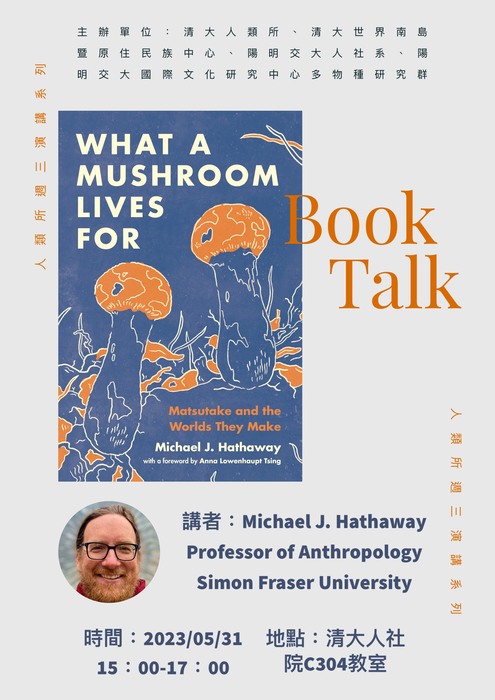
Date:2023/5/31
Speaker:Michael J. Hathaway
Location:HSS C304
Time:15:00-17:00
Online Link: https://meet.google.com/upr-rpxp-ynf
Summary:
What a Mushroom Lives For pushes today’s mushroom renaissance in compelling new directions. For centuries, Western science has promoted a human-and animal-centric framework of what counts as action, agency, movement, and behavior. But, as this talk demonstrates, the world-making capacity of mushrooms radically challenges this orthodoxy by revealing the livelily dynamism of all forms of life.
The book and lecture tell the fascinating story of one particularly prized species, the matsutake, and the astonishing ways it is silently yet powerfully shaping worlds, from the Tibetan plateau to the mushrooms’ final destination in Japan. Many Tibetan and Yi people have dedicated their lives to picking and selling this mushroom – a delicacy that drives a multibillion-dollar global trade network and that still grows only in the wild, despite scientists’ intensive efforts to cultivate it in urban lands. But this is far from a simple story of humans exploiting a passive edible commodity. Rather, the book and talk reveal the complex, symbiotic ways that mushrooms, plants, humans, and other animals interact. It explores how the world looks to the mushrooms, as well as to the people who have grown rich harvesting them.
Speaker:Michael J. Hathaway
Location:HSS C304
Time:15:00-17:00
Online Link: https://meet.google.com/upr-rpxp-ynf
Summary:
What a Mushroom Lives For pushes today’s mushroom renaissance in compelling new directions. For centuries, Western science has promoted a human-and animal-centric framework of what counts as action, agency, movement, and behavior. But, as this talk demonstrates, the world-making capacity of mushrooms radically challenges this orthodoxy by revealing the livelily dynamism of all forms of life.
The book and lecture tell the fascinating story of one particularly prized species, the matsutake, and the astonishing ways it is silently yet powerfully shaping worlds, from the Tibetan plateau to the mushrooms’ final destination in Japan. Many Tibetan and Yi people have dedicated their lives to picking and selling this mushroom – a delicacy that drives a multibillion-dollar global trade network and that still grows only in the wild, despite scientists’ intensive efforts to cultivate it in urban lands. But this is far from a simple story of humans exploiting a passive edible commodity. Rather, the book and talk reveal the complex, symbiotic ways that mushrooms, plants, humans, and other animals interact. It explores how the world looks to the mushrooms, as well as to the people who have grown rich harvesting them.